
ESKUTE V100 vs V300
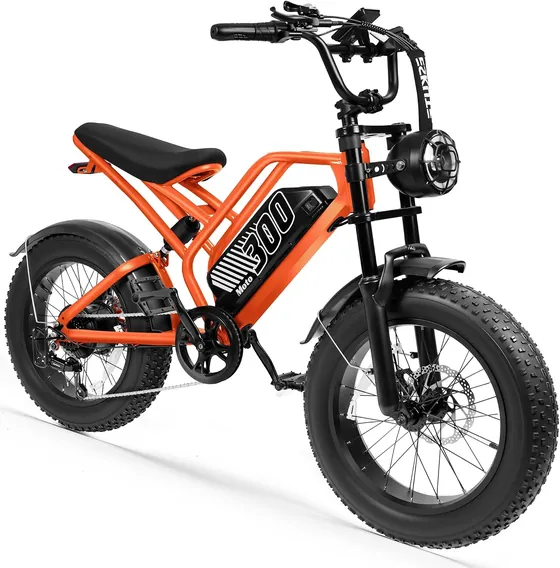
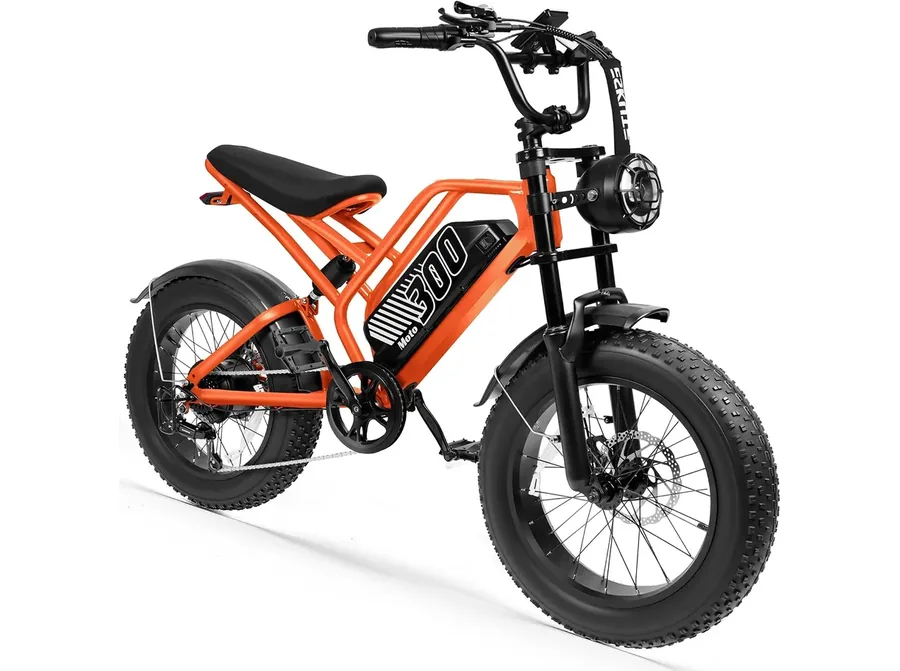
Both bikes share the moped-style frame, the long seat, the 1500W peak motor and the 7-speed drivetrain. So why does the ESKUTE V300 20" Fat Tire Electric Bike sit above the ESKUTE V100 16" Fat Tire Electric Bike? It comes down to three things: wheel size, battery and riding modes. Everything else follows from those. The figures here come from ESKUTE's product details and the V100's spec sheet.
Difference 1: wheel size
The V100 rolls on 16" x 4.0" tires and the V300 on 20" x 4.0". Both have full suspension (a front fork and rear shock on the V100), so the bigger change is the wheel itself. A 20" wheel rolls over potholes, roots and curb edges more easily, and ESKUTE pitches the V300 for paved roads, mountain roads, beach sand, snow and mud. The 16" V100 is the smaller, shorter bike. It's easier to park in a hallway or lift into a truck bed.
Difference 2: battery and range
| V100 | V300 | |
|---|---|---|
| Battery | 48V 13Ah (about 624 Wh) | 48V 20.8Ah (about 998 Wh); 41.6Ah version offered |
| Range (ESKUTE) | Up to 60 mi, pedal assist | Up to 85 mi max, pedal assist |
| Charging | 4 to 6 h, 54.6V 1.5A charger | On the bike or removed indoors |
The V300's standard pack holds about 60% more energy than the V100's. ESKUTE also offers a 48V 41.6Ah version. Both range figures assume pedal assist, and riding on the throttle alone covers less distance on either bike. If your daily round trip is long, the V300's numbers matter more than anything else here.
Difference 3: how many ways to ride
The V100 has three modes: throttle only, pedal assist, and pedaling with the motor off. The V300 has five: pure electric, pedal assist and manual pedaling, plus Boost for extra punch and Cruise for holding a steady speed on long flat stretches.
Everything else, side by side
| V100 | V300 | |
|---|---|---|
| Peak motor | 1500W | 1500W, 90 N·m torque |
| Top speed | — | 30+ mph |
| Climbing | Not stated | Up to 35° |
| Gears | 7-speed, twist-grip shifter | 7-speed |
| Brakes | Dual disc | Disc, hydraulic rear |
| Display | Digital display | Center-mounted full-color LCD |
| Unlock | Key | NFC card, keyless |
| Lights | Taillight | Headlight and rear brake light |
| Extras | Front and rear fenders; 120 lb rear rack | High-carbon steel frame |
| Weight | 70.5 lb | Not stated |
A few details stand out:
- The V100's motor only engages after you give the brake lever a light squeeze. That stops the bike from lurching forward if the throttle gets bumped while you climb on, which is a useful safeguard for a new or younger rider.
- The V300's NFC card means there's no key to lose, and its color screen shows speed, battery, mode and distance at a glance.
- Check local e-bike rules before you ride either bike on public roads.
Who should get which
The V100 suits you if...
- Storage space is tight, or the bike has to go up steps or into a car.
- Your rides are campus loops, park paths or short commutes.
- You're 5'0" to 6'2", ESKUTE's fit range, and want a 28.3" minimum seat height.
The V300 suits you if...
- You ride long distances, or you'd rather charge the battery at your desk than next to the bike.
- Your routes mix pavement with sand, gravel or snow.
- You want Cruise mode for steady stretches, Boost for hills and a keyless start.
Both bikes, and the rest of ESKUTE's pedal models, are on Fat Tire E-Bikes. The ESKUTE review covers the whole lineup.